
Be Prepared
Difficult days are coming upon Earth, and the desire of our Heavenly Father is that we, as believers, are prepared.
He instructs us to live righteously as we watch expectantly for His Son’s glorious return (1 Thessalonians 5:4-10). In this regard, He has provided for us a wealth of vital prophetic information through His inspired penmen – the apostles and prophets.
You and I – or perhaps our sons, daughters, or grandchildren – may be among the generation of believers called upon to face the onslaught of Satan’s End Time advances on Earth prior to the triumphant return of Jesus Christ.
Admittedly, this is a sobering thought. But if we and those we love are to remain faithful and emerge victorious, it is crucial we understand the enemy’s strategic assault plan as revealed in the prophetic Scriptures.
In the previous post of this series, we saw the vital connection of 3 epic visions given by God to the Apostle John in Revelation chapters 12, 13, and 17. Through vivid symbolism, these 3 visions reveal both the historic and future strategy of the Wicked One to thwart God’s plan for the redemption of humanity.
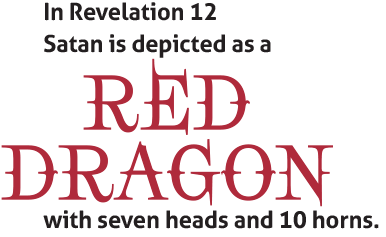
Revelation 12 begins with a depiction of Satan as a red dragon with 7 heads, 10 horns, and 7 crowns. A pregnant woman is seen in Heaven struggling to give birth. She is clothed with the sun, has the moon under her feet, and is crowned with 12 stars.
The dragon stands ready to devour her child as soon as He’s born. But her Son, Jesus Christ – the One who is destined to rule the nations as King of the earth – is caught up to the very throne room of God in Heaven.
Difficult days are coming upon Earth, and the desire of our Heavenly Father is that we, as believers, are prepared.
He instructs us to live righteously as we watch expectantly for His Son’s glorious return (1 Thessalonians 5:4-10). In this regard, He has provided for us a wealth of vital prophetic information through His inspired penmen – the apostles and prophets.
You and I – or perhaps our sons, daughters, or grandchildren – may be among the generation of believers called upon to face the onslaught of Satan’s End Time advances on Earth prior to the triumphant return of Jesus Christ.
Admittedly, this is a sobering thought. But if we and those we love are to remain faithful and emerge victorious, it is crucial we understand the enemy’s strategic assault plan as revealed in the prophetic Scriptures.
In the previous post of this series, we saw the vital connection of 3 epic visions given by God to the Apostle John in Revelation chapters 12, 13, and 17. Through vivid symbolism, these 3 visions reveal both the historic and future strategy of the Wicked One to thwart God’s plan for the redemption of humanity.
Revelation 12 begins with a depiction of Satan as a red dragon with 7 heads, 10 horns, and 7 crowns. A pregnant woman is seen in Heaven struggling to give birth. She is clothed with the sun, has the moon under her feet, and is crowned with 12 stars.
The dragon stands ready to devour her child as soon as He’s born. But her Son, Jesus Christ – the One who is destined to rule the nations as King of the earth – is caught up to the very throne room of God in Heaven.
In the vision, the woman symbolizes the nation of Israel in her historic struggle to give birth to the Savior of the world. Together, this imagery is intended to depict the central role of Israel in God’s redemptive plan and to reveal the diabolic strategy of Satan to defeat Jesus Christ at His first coming.
The dragon is depicted as having 7 heads. These heads have no relationship to the Seven Hills of Rome as is sometimes suggested.
As explained in recent posts, the heads are symbolic of 7 powerful kingdoms that arose through history. These kingdoms have been an integral component of Satan’s master plan and have been used by him in an attempt to annihilate or assimilate Israel – the woman clothed with the sun.
Satan’s hatred of Israel is inseparably linked to his understanding that she was sovereignly chosen by God to give birth to the Promised Seed, Jesus Christ, who was destined to crush his head.
Further on in the same chapter, John’s symbolic vision leaps to a future time just prior to Christ’s Second Coming, when the dragon (Satan) is cast out of Heaven to Earth. Enraged, he is seen pursuing the woman (Israel) as she flees into the wilderness to escape his persecution:
The dragon is depicted as having 7 heads. These heads have no relationship to the Seven Hills of Rome as is sometimes suggested.
As explained in recent posts, the heads are symbolic of 7 powerful kingdoms that arose through history. These kingdoms have been an integral component of Satan’s master plan and have been used by him in an attempt to annihilate or assimilate Israel – the woman clothed with the sun.
Satan’s hatred of Israel is inseparably linked to his understanding that she was sovereignly chosen by God to give birth to the Promised Seed, Jesus Christ, who was destined to crush his head.
Further on in the same chapter, John’s symbolic vision leaps to a future time just prior to Christ’s Second Coming, when the dragon (Satan) is cast out of Heaven to Earth. Enraged, he is seen pursuing the woman (Israel) as she flees into the wilderness to escape his persecution:
“Woe to the inhabitants of the earth and of the sea! for the devil is come down unto you, having great wrath, because he knoweth that he hath but a short time. And when the dragon saw that he was cast unto the earth, he persecuted the woman which brought forth the man child” (Revelation 12:12-13).
In the very next chapter, Revelation 13, John’s second vision addresses the question of how Satan will pursue and persecute both Israel and Gentile believers living in the Last Days – and whom he’ll use to do it.
John describes a beast that rises up from the sea with 7 heads, 10 horns, 10 crowns on his horns, and upon his heads the name of blasphemy. This vicious creature is depicted as a leopard, with feet like a bear, and a mouth like a lion.
While this beast embodies many of the same prominent features as the red dragon in the previous chapter, there are obvious distinctions. Two important differences are the number and placement of the crowns.
The red dragon is depicted with 7 crowns, and they are on his 7 heads. This depiction symbolizes Satan’s control over the 7 kings that are associated with these 7 empires through history.
However, this new beast John sees rising from the sea (from the nations) has 10 crowns, and they are positioned on his 10 horns. We will discuss the 10 horns in greater detail further on in this series. But what is important to understand at this point is that the 10 horns are intended to symbolize one additional kingdom – bringing the total number of kingdoms to 8.
This 8th kingdom will rise in the Last Days and will be comprised of 10 nations, each with an associated king. These leaders will unify and give their power and authority to one prominent individual who will rule over their collective empire.
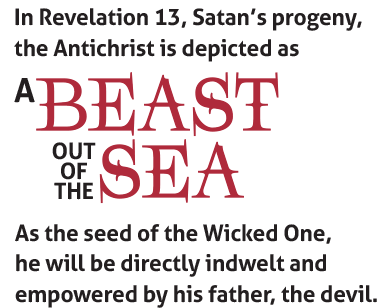
So the beast in Revelation 13 that John sees rising from the sea with 10 crowns on his 10 horns is symbolic of the future final beast empire that will rise from among the Gentile world and be ruled over by Satan’s progeny, the Antichrist. As the seed of the Wicked One, he will be directly indwelt and empowered by his father, the devil.
Four chapters later, in Revelation 17, John sees another woman, but she is not a lady of noble character. In stark contrast to his earlier vision of a woman in Heaven who is clothed with the sun and crowned with 12 stars, this woman is a vile harlot who flaunts her wealth, dresses to seduce kings, and is drunk on the blood of the saints and martyrs of Jesus Christ.
Upon her forehead is a name: Mystery, Babylon the Great, The Mother of Harlots and Abominations of the Earth. She is in the wilderness, and seated upon a scarlet-colored beast, full of the names of blasphemy, having 7 heads and 10 horns.
The purpose of this vision is two-fold. First, it serves to identify, through symbolism, Satan’s evil cohorts (i.e. the beast and a wicked harlot) and their synergistic relationship in this winner-take-all, end-times drama. Second, it further exposes Satan’s agenda and reveals the shocking and horrific future judgment of his infamous co-conspirator – the harlot of Babylon.
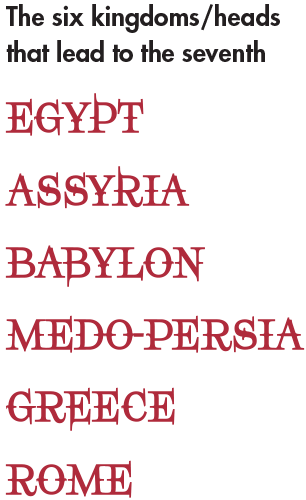
But this brings us back to the question of the beast she rides, the identity of its heads (kingdoms) and their associated kings. Again, the identification of specific rulers associated with each kingdom seems clear in some cases – and yet in others is more difficult to determine. Below is a list of what I believe to be plausible identifications of these historic kings:
John describes a beast that rises up from the sea with 7 heads, 10 horns, 10 crowns on his horns, and upon his heads the name of blasphemy. This vicious creature is depicted as a leopard, with feet like a bear, and a mouth like a lion.
While this beast embodies many of the same prominent features as the red dragon in the previous chapter, there are obvious distinctions. Two important differences are the number and placement of the crowns.
The red dragon is depicted with 7 crowns, and they are on his 7 heads. This depiction symbolizes Satan’s control over the 7 kings that are associated with these 7 empires through history.
However, this new beast John sees rising from the sea (from the nations) has 10 crowns, and they are positioned on his 10 horns. We will discuss the 10 horns in greater detail further on in this series. But what is important to understand at this point is that the 10 horns are intended to symbolize one additional kingdom – bringing the total number of kingdoms to 8.
This 8th kingdom will rise in the Last Days and will be comprised of 10 nations, each with an associated king. These leaders will unify and give their power and authority to one prominent individual who will rule over their collective empire.
So the beast in Revelation 13 that John sees rising from the sea with 10 crowns on his 10 horns is symbolic of the future final beast empire that will rise from among the Gentile world and be ruled over by Satan’s progeny, the Antichrist. As the seed of the Wicked One, he will be directly indwelt and empowered by his father, the devil.
Four chapters later, in Revelation 17, John sees another woman, but she is not a lady of noble character. In stark contrast to his earlier vision of a woman in Heaven who is clothed with the sun and crowned with 12 stars, this woman is a vile harlot who flaunts her wealth, dresses to seduce kings, and is drunk on the blood of the saints and martyrs of Jesus Christ.
Upon her forehead is a name: Mystery, Babylon the Great, The Mother of Harlots and Abominations of the Earth. She is in the wilderness, and seated upon a scarlet-colored beast, full of the names of blasphemy, having 7 heads and 10 horns.
The purpose of this vision is two-fold. First, it serves to identify, through symbolism, Satan’s evil cohorts (i.e. the beast and a wicked harlot) and their synergistic relationship in this winner-take-all, end-times drama. Second, it further exposes Satan’s agenda and reveals the shocking and horrific future judgment of his infamous co-conspirator – the harlot of Babylon.
But this brings us back to the question of the beast she rides, the identity of its heads (kingdoms) and their associated kings. Again, the identification of specific rulers associated with each kingdom seems clear in some cases – and yet in others is more difficult to determine. Below is a list of what I believe to be plausible identifications of these historic kings:
1. Egypt and the Pharaoh “who knew not” Joseph:
Initially, the Jews prospered down in Egypt during the life of Joseph. In time, however, they were enslaved and the command was given that all Hebrew male children were to be slain at birth (Exodus 1:15-16). Only the action of the midwives, who did not obey Pharaoh’s command, prevented this from occurring (Exodus 1:17).
2. Assyria and Tiglath-Pileser or Sennacherib:
Infamous for its cruelty, the Assyrian army, under Tiglath-Pileser, invaded and took captive the 10 northern tribes of Israel in 722 B.C. Less than 20 years later, in approximately 701 B.C., Sennacherib of Assyria attacked the southern kingdom of Judah and besieged Jerusalem. As his army encamped outside the city on the night before their attack, the Angel of the Lord destroyed 185,000 Assyrian soldiers (2 Kings 15:29; 2 Kings 19:35).
3. Babylon and Nebuchadnezzar:
Three times in a 20-year period the Babylonian army, under Nebuchadnezzar, sacked Jerusalem. On the final attack in 586 B.C., he burned the Temple on Mount Moriah, put an end to the sacrificial system, and plucked out the eyes of Zedekiah, who was the last king in the Davidic lineage to reign (2 Kings 25:7).
4. Medo-Persia and Haman:
In the 4th Century B.C., a decree was sent out by Persian king Artaxerxes (initiated by his second-in-command, Haman) announcing that the Jewish population in all 127 provinces of the Persian Empire were to be slain on a specific day. Only the intervention by Queen Esther, a secret Jewess, and her cousin Mordecai prevented the annihilation of the Jews (Esther 3:13).
5. Greece and Antiochus Epiphanes:
Following Alexander the Great’s rapid conquest of territory stretching from Macedonia in the west to India in the east, and to Egypt in the south, the young military general unexpectedly died at the young age of 32.
Four of his generals then divided up the massive Grecian Empire. Eventually Antiochus Epiphanes rose to power in the region of Syria. He marched into Jerusalem and desecrated the rebuilt Temple on Mount Moriah by slaughtering a pig on the altar. He erected a statue of his pagan god Zeus in the Holy of Holies and demanded the Jews worship him. Many of the Jewish people who refused were martyred (Daniel 11:21-35).
6. Rome and Emperor Vespasian or General Titus:
In A.D. 67, Emperor Nero in Rome dispatched Vespasian to quell the Jewish rebellion in Israel. According to Josephus, Vespasian’s army may have killed or enslaved as many as 100,000 Jewish Galileans before setting up his base of operations in Caesarea Maritima.
After Nero committed suicide, Vespasian rushed back to Rome to proclaim himself Emperor, leaving his son General Titus in charge of the conquest of Jerusalem. In A.D. 70, following a 7-month siege, Titus eventually broke through the city walls, looted the Temple, and set it on fire. Tens of thousands of Jews were killed, and many were taken to Rome as slaves.
Initially, the Jews prospered down in Egypt during the life of Joseph. In time, however, they were enslaved and the command was given that all Hebrew male children were to be slain at birth (Exodus 1:15-16). Only the action of the midwives, who did not obey Pharaoh’s command, prevented this from occurring (Exodus 1:17).
2. Assyria and Tiglath-Pileser or Sennacherib:
Infamous for its cruelty, the Assyrian army, under Tiglath-Pileser, invaded and took captive the 10 northern tribes of Israel in 722 B.C. Less than 20 years later, in approximately 701 B.C., Sennacherib of Assyria attacked the southern kingdom of Judah and besieged Jerusalem. As his army encamped outside the city on the night before their attack, the Angel of the Lord destroyed 185,000 Assyrian soldiers (2 Kings 15:29; 2 Kings 19:35).
3. Babylon and Nebuchadnezzar:
Three times in a 20-year period the Babylonian army, under Nebuchadnezzar, sacked Jerusalem. On the final attack in 586 B.C., he burned the Temple on Mount Moriah, put an end to the sacrificial system, and plucked out the eyes of Zedekiah, who was the last king in the Davidic lineage to reign (2 Kings 25:7).
4. Medo-Persia and Haman:
In the 4th Century B.C., a decree was sent out by Persian king Artaxerxes (initiated by his second-in-command, Haman) announcing that the Jewish population in all 127 provinces of the Persian Empire were to be slain on a specific day. Only the intervention by Queen Esther, a secret Jewess, and her cousin Mordecai prevented the annihilation of the Jews (Esther 3:13).
5. Greece and Antiochus Epiphanes:
Following Alexander the Great’s rapid conquest of territory stretching from Macedonia in the west to India in the east, and to Egypt in the south, the young military general unexpectedly died at the young age of 32.
Four of his generals then divided up the massive Grecian Empire. Eventually Antiochus Epiphanes rose to power in the region of Syria. He marched into Jerusalem and desecrated the rebuilt Temple on Mount Moriah by slaughtering a pig on the altar. He erected a statue of his pagan god Zeus in the Holy of Holies and demanded the Jews worship him. Many of the Jewish people who refused were martyred (Daniel 11:21-35).
6. Rome and Emperor Vespasian or General Titus:
In A.D. 67, Emperor Nero in Rome dispatched Vespasian to quell the Jewish rebellion in Israel. According to Josephus, Vespasian’s army may have killed or enslaved as many as 100,000 Jewish Galileans before setting up his base of operations in Caesarea Maritima.
After Nero committed suicide, Vespasian rushed back to Rome to proclaim himself Emperor, leaving his son General Titus in charge of the conquest of Jerusalem. In A.D. 70, following a 7-month siege, Titus eventually broke through the city walls, looted the Temple, and set it on fire. Tens of thousands of Jews were killed, and many were taken to Rome as slaves.
The Identification of the 7th Kingdom
This brings us to the 7th kingdom, and what I believe, in certain respects, to be the most challenging of all to determine. Beginning in Revelation 17:9, John writes:
This brings us to the 7th kingdom, and what I believe, in certain respects, to be the most challenging of all to determine. Beginning in Revelation 17:9, John writes:
“And here is the mind which hath wisdom. The seven heads are seven mountains [kingdoms/empires], on which the woman sitteth. And there are seven kings, five are fallen [Egypt, Assyria, Babylon, Medo-Persia, and Greece], and one is [Rome], and the other is not yet come; and when he cometh, he must continue a short space” (Revelation 17:9-10).
In determining the identity of the 7th kingdom, several important factors help narrow the possibilities:
1. The Chronology of Empires: The 7th kingdom had not yet risen to power in John’s day. Obviously, since Rome was ruling at the time of John’s writing, the potential candidates are restricted to the empires that ruled over the land of Israel – and specifically Jerusalem – after the fall of the Roman Empire.
2. The Continuity of Empires: Not simply chronology, but continuity is important for the purpose of identifying the 7th empire. The first 6 were successive empires that arose one after the other, without interruption. Egypt rose to power and was defeated by the Assyrians in 671 B.C. In turn, Assyria fell to the Babylonians in 612 B.C.
The Babylonian Empire then fell to the Medo-Persians in 539 B.C. The Medo-Persian Empire fell by the hand of Alexander the Great in 330 B.C. as the Grecian Empire rose to power. The Greeks then fell to the Romans in 146 B.C.
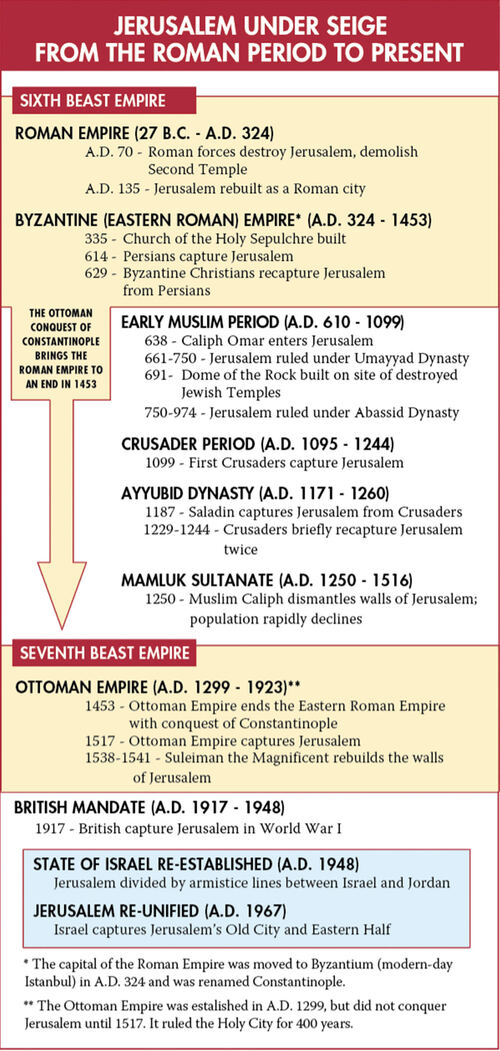
Eventually, the capital of the Roman Empire was moved by Emperor Constantine from Rome to the ancient city of Byzantium (modern-day Istanbul, Turkey) which was renamed Constantinople.
What became known historically as the Byzantine Empire was in reality the continuation of the Roman Empire in the east – and it remained in existence until the fall of Constantinople in 1453 to the Ottomans by the hand of the Islamic Sultan, Mehmed the Conqueror. However, when the Ottoman Empire rose to power, it did not initially control Jerusalem and the Holy Land.
In prior years, Jerusalem had been captured and recaptured by various Muslim dynasties and multiple crusader conquests between the years A.D. 638 and 1244. But now, the newly established Islamic Ottoman Empire was rising.
In 1517, the first official Ottoman Caliph – Selim I – more than doubled the land area of the empire by conquering the Mamluk Sultanate headquartered in Egypt, along with its vast territories. As a result, the Ottomans controlled nearly all of the Middle East including Jerusalem, the Holy Land, and the Muslim holy cities of Mecca and Medina (which are in modern-day Saudi Arabia).
Thus, Jerusalem and the Holy Land now fell under the dominion and rule of the Islamic Ottoman Empire. This remained in effect for 400 years until the dissolution of the empire in 1917, at the end of World War I.
However, this long period of 400 years raises a significant challenge. In Revelation 17:10, John states, “the other [the 7th empire] is not yet come; and when he cometh, he must continue a short space.”
1. The Chronology of Empires: The 7th kingdom had not yet risen to power in John’s day. Obviously, since Rome was ruling at the time of John’s writing, the potential candidates are restricted to the empires that ruled over the land of Israel – and specifically Jerusalem – after the fall of the Roman Empire.
2. The Continuity of Empires: Not simply chronology, but continuity is important for the purpose of identifying the 7th empire. The first 6 were successive empires that arose one after the other, without interruption. Egypt rose to power and was defeated by the Assyrians in 671 B.C. In turn, Assyria fell to the Babylonians in 612 B.C.
The Babylonian Empire then fell to the Medo-Persians in 539 B.C. The Medo-Persian Empire fell by the hand of Alexander the Great in 330 B.C. as the Grecian Empire rose to power. The Greeks then fell to the Romans in 146 B.C.
Eventually, the capital of the Roman Empire was moved by Emperor Constantine from Rome to the ancient city of Byzantium (modern-day Istanbul, Turkey) which was renamed Constantinople.
What became known historically as the Byzantine Empire was in reality the continuation of the Roman Empire in the east – and it remained in existence until the fall of Constantinople in 1453 to the Ottomans by the hand of the Islamic Sultan, Mehmed the Conqueror. However, when the Ottoman Empire rose to power, it did not initially control Jerusalem and the Holy Land.
In prior years, Jerusalem had been captured and recaptured by various Muslim dynasties and multiple crusader conquests between the years A.D. 638 and 1244. But now, the newly established Islamic Ottoman Empire was rising.
In 1517, the first official Ottoman Caliph – Selim I – more than doubled the land area of the empire by conquering the Mamluk Sultanate headquartered in Egypt, along with its vast territories. As a result, the Ottomans controlled nearly all of the Middle East including Jerusalem, the Holy Land, and the Muslim holy cities of Mecca and Medina (which are in modern-day Saudi Arabia).
Thus, Jerusalem and the Holy Land now fell under the dominion and rule of the Islamic Ottoman Empire. This remained in effect for 400 years until the dissolution of the empire in 1917, at the end of World War I.
However, this long period of 400 years raises a significant challenge. In Revelation 17:10, John states, “the other [the 7th empire] is not yet come; and when he cometh, he must continue a short space.”

In the English language, the normative reading would seem to make clear that the future 7th empire to which John is alluding would be on the scene for a short period of time.
Admittedly, this creates a challenge for biblical scholars, as neither the historic Islamic Caliphates nor the Ottoman Empire existed for a short period of time. It’s possible John’s emphasis here is not so much on the brevity of the 7th empire, but more on the fact that the 7th empire would rise and come to an end as did the previous 6.
Another possible answer may be found in the Greek word oligon that has been translated as “short space” in the KJV. In many instances, the word can also be translated “little while.” But on occasion, it can simply be translated, “a while.”
In other words, oligon allows for the possibility that what John is actually saying is: “Yes, there is a 7th empire coming, and it will remain for a while, but ultimately will not remain. It’s going to be here and then give way to something bigger.” This would allow for an empire of longer duration such as the Islamic Ottoman Caliphate.
3. The Natural Grouping of the First 7 Empires: In John’s description, he uses very few words when alluding to the 7th empire. It’s as if he assumes his readers will understand the natural progression from the first 6 to the 7th empire. In this regard, it would seem he is grouping these first 7 together due to their similar nature.
The Ottoman Caliphate, as the 7th, fits neatly within the grouping of the previous 6. In contrast, the 8th empire, which is the empire of the Antichrist, is uniquely distinct and set apart from the previous 7 empires.
4. The Geographic Relationship of the First 7 Empires: The territorial areas captured and controlled by the Islamic Ottoman Empire at the height of its power have a consistent geographic relationship with the previous 6 empires. Essentially, any kingdom or empire outside of the geographic region of the greater Middle East would seem to be an unlikely candidate for the 7th empire.
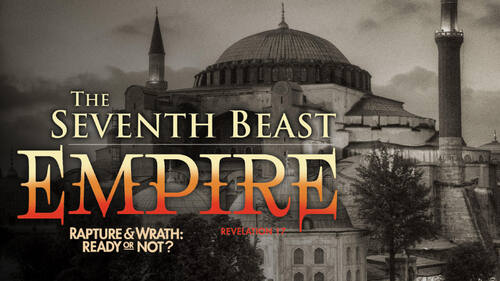
In conclusion, it seems likely that the Islamic Ottoman Empire was the 7th head on the beast in John’s apocalyptic vision. And while I am not dogmatic concerning this identification, I do believe it best fits the necessary criteria.
More importantly, an 8h and final beast empire is yet to come. According to John, this beast lived once before, and died. In the Last Days it will rise from the dead to become the most powerful weapon of Satan’s final attack against a remnant of faithful Jews and Christians.
“And the beast that was, and is not, even he is the eighth, and is of the seven, and goeth into perdition [judgment].”
The empire of the Antichrist will be the subject of the next post in this series.
Admittedly, this creates a challenge for biblical scholars, as neither the historic Islamic Caliphates nor the Ottoman Empire existed for a short period of time. It’s possible John’s emphasis here is not so much on the brevity of the 7th empire, but more on the fact that the 7th empire would rise and come to an end as did the previous 6.
Another possible answer may be found in the Greek word oligon that has been translated as “short space” in the KJV. In many instances, the word can also be translated “little while.” But on occasion, it can simply be translated, “a while.”
In other words, oligon allows for the possibility that what John is actually saying is: “Yes, there is a 7th empire coming, and it will remain for a while, but ultimately will not remain. It’s going to be here and then give way to something bigger.” This would allow for an empire of longer duration such as the Islamic Ottoman Caliphate.
3. The Natural Grouping of the First 7 Empires: In John’s description, he uses very few words when alluding to the 7th empire. It’s as if he assumes his readers will understand the natural progression from the first 6 to the 7th empire. In this regard, it would seem he is grouping these first 7 together due to their similar nature.
The Ottoman Caliphate, as the 7th, fits neatly within the grouping of the previous 6. In contrast, the 8th empire, which is the empire of the Antichrist, is uniquely distinct and set apart from the previous 7 empires.
4. The Geographic Relationship of the First 7 Empires: The territorial areas captured and controlled by the Islamic Ottoman Empire at the height of its power have a consistent geographic relationship with the previous 6 empires. Essentially, any kingdom or empire outside of the geographic region of the greater Middle East would seem to be an unlikely candidate for the 7th empire.
In conclusion, it seems likely that the Islamic Ottoman Empire was the 7th head on the beast in John’s apocalyptic vision. And while I am not dogmatic concerning this identification, I do believe it best fits the necessary criteria.
More importantly, an 8h and final beast empire is yet to come. According to John, this beast lived once before, and died. In the Last Days it will rise from the dead to become the most powerful weapon of Satan’s final attack against a remnant of faithful Jews and Christians.
“And the beast that was, and is not, even he is the eighth, and is of the seven, and goeth into perdition [judgment].”
The empire of the Antichrist will be the subject of the next post in this series.
Naomi: Tears to Triumph
April 23rd, 2026
It was more of an embittered accusation than a plea for mercy. But now was not the time to rail against God; Naomi had a crucial decision to make. As she paced alongside the main road that led out of the heathen nation of Moab, Naomi rehearsed her words. Two women and three mules were awaiting her decision. Satisfied she had found the right words, she returned to her companions. “Ruth, Orpah, plea...
Rapture & Wrath, Part 14: “The Empire of the Antichrist” (Revelation 17)
April 23rd, 2026
The identification of 7 historical empires used by Satan to accomplish his strategic purposes has been a central focus in this series of posts. In 3 different visions recorded in Revelation chapters 12, 13, and 17, John references a beast with 7 heads and 10 horns.
As the symbolism and significance of these heads and horns are revealed in the light of the prophetic Scriptures, the darkness that e...
Rapture & Wrath, Part 13: “The Seventh Beast Empire” (Revelation 17)
April 23rd, 2026
Difficult days are coming upon Earth, and the desire of our Heavenly Father is that we, as believers, are prepared.
He instructs us to live righteously as we watch expectantly for His Son’s glorious return (1 Thessalonians 5:4-10). In this regard, He has provided for us a wealth of vital prophetic information through His inspired penmen – the apostles and prophets.
You and I – or perhaps our so...