
A Tale of 2 Chapters
The blackest of storms often gives way to the most beautiful of sunsets. Such is the case in Revelation Chapters 13 and 14. Chapter 13 is black and foreboding. Apart from the crucifixion of Jesus, not since the serpent beguiled Adam and Eve in the Garden and brought sin and death into the world has there been a comparable period of evil and wickedness.
In Chapter 13 we feel the sickening shock of horror at the very contemplation of Satan’s hellish power, blasphemies of God, and unparalleled tyranny of humanity, and we ask, “Who is this wicked created being that he presumes to think he can defy the living God?”
In Chapter 13 we gaze upon the falsely deified Antichrist and his malignant program for Earth and we ask, “Who is this progeny of Hell that he dares to think he can usurp the throne of the King of glory?”
In Chapter 13 we watch the thickening evil and darkness of the False Prophet who looks like a lamb but speaks as a dragon and who, with devilish lies, intoxicates the nations that refuse to have Christ rule over them, and we ask, “Who is this liar and deceiver that he naively believes he can supplant the true prophets of God?” Here then is the manifestation of Hell’s ultimate power and humanity’s sinful susceptibility to it.
Revelation Chapter 13 records the midnight of human history. Death and darkness appear to have vanquished life and light. It is the time of Great Tribulation, and if God does not intervene, all believing flesh will perish (Matthew 24:21-22).
A Lamb Standing on Mount Zion
Chapter 14 opens with these words: “And I looked, and, lo, a Lamb stood on the mount [Zion]” (verse 1). Who is this Lamb who suddenly appears on the scene? Clearly, this Lamb is not the beast who arose out of the earth having two horns like a lamb and speaking as a dragon (Revelation 13:11). No, this Lamb is familiar to us. We encountered Him in Chapter 5.
We are told this Lamb is standing on Mount Zion (Revelation 14:1). This is precisely where we would expect to find Him. For, paradoxically, this Lamb is also a lion. He is the Lion of the tribe of Judah (Genesis 49:10; Revelation 5:5). In His flesh, He is the descendant of King David.
King David captured a fortified city called Jebus, which was inhabited by a war-like, idolatrous people called the Jebusites (2 Samuel 5:6-7). After capturing the city, He made it his capital, and it became known as the City of David (2 Samuel 5:9) and Zion.
In time, the term “Zion” was revived and widened to refer to the entire western ridge of early Jerusalem. The walled city of Jerusalem eventually included the Temple Mount on Mount Moriah. Centuries later, the term “Zion” was applied to the entire city of Jerusalem (Psalm 126:1; Isaiah 1:26-27). And Jerusalem is the heart of Israel.
The Lamb is seen standing in the midst of His earthly capital. This is the prophecy recorded in Psalm 2 and which will find fulfillment during Daniel’s 70th Week (the final 7 years of this era of human history). In that prophecy, God decreed: “Yet [that is, in spite of all that rebellious men can do to oppose God’s purposes] have I set my king upon my holy hill of Zion” (Psalm 2:6), and now He is standing there.
The blackest of storms often gives way to the most beautiful of sunsets. Such is the case in Revelation Chapters 13 and 14. Chapter 13 is black and foreboding. Apart from the crucifixion of Jesus, not since the serpent beguiled Adam and Eve in the Garden and brought sin and death into the world has there been a comparable period of evil and wickedness.
In Chapter 13 we feel the sickening shock of horror at the very contemplation of Satan’s hellish power, blasphemies of God, and unparalleled tyranny of humanity, and we ask, “Who is this wicked created being that he presumes to think he can defy the living God?”
In Chapter 13 we gaze upon the falsely deified Antichrist and his malignant program for Earth and we ask, “Who is this progeny of Hell that he dares to think he can usurp the throne of the King of glory?”
In Chapter 13 we watch the thickening evil and darkness of the False Prophet who looks like a lamb but speaks as a dragon and who, with devilish lies, intoxicates the nations that refuse to have Christ rule over them, and we ask, “Who is this liar and deceiver that he naively believes he can supplant the true prophets of God?” Here then is the manifestation of Hell’s ultimate power and humanity’s sinful susceptibility to it.
Revelation Chapter 13 records the midnight of human history. Death and darkness appear to have vanquished life and light. It is the time of Great Tribulation, and if God does not intervene, all believing flesh will perish (Matthew 24:21-22).
A Lamb Standing on Mount Zion
Chapter 14 opens with these words: “And I looked, and, lo, a Lamb stood on the mount [Zion]” (verse 1). Who is this Lamb who suddenly appears on the scene? Clearly, this Lamb is not the beast who arose out of the earth having two horns like a lamb and speaking as a dragon (Revelation 13:11). No, this Lamb is familiar to us. We encountered Him in Chapter 5.
We are told this Lamb is standing on Mount Zion (Revelation 14:1). This is precisely where we would expect to find Him. For, paradoxically, this Lamb is also a lion. He is the Lion of the tribe of Judah (Genesis 49:10; Revelation 5:5). In His flesh, He is the descendant of King David.
King David captured a fortified city called Jebus, which was inhabited by a war-like, idolatrous people called the Jebusites (2 Samuel 5:6-7). After capturing the city, He made it his capital, and it became known as the City of David (2 Samuel 5:9) and Zion.
In time, the term “Zion” was revived and widened to refer to the entire western ridge of early Jerusalem. The walled city of Jerusalem eventually included the Temple Mount on Mount Moriah. Centuries later, the term “Zion” was applied to the entire city of Jerusalem (Psalm 126:1; Isaiah 1:26-27). And Jerusalem is the heart of Israel.
The Lamb is seen standing in the midst of His earthly capital. This is the prophecy recorded in Psalm 2 and which will find fulfillment during Daniel’s 70th Week (the final 7 years of this era of human history). In that prophecy, God decreed: “Yet [that is, in spite of all that rebellious men can do to oppose God’s purposes] have I set my king upon my holy hill of Zion” (Psalm 2:6), and now He is standing there.
The 144,000 on Mount Zion
But the King is not a solitary figure. He is not alone on Mount Zion. John tells us: “and with him an [144,000], having his Father’s name written [on] their foreheads” (Revelation 14:1). The relevance of this statement cannot be overstated.
John is informing his readers that although the power of Hell in all of its strength, fury, and deception is being unleashed against the earth during the Great Tribulation as described in Chapter 13, God still has a faithful remnant. His Son is not a king without subjects; not all of Earth’s inhabitants have taken the mark of the Antichrist during the Great Tribulation.
As to the identity of this 144,000 there should be absolutely no question. They are Jews who have trusted Jesus. They are the same 144,000 who were sealed in Revelation 7:1-8. The seal indicated 2 critical truths. First, the 144,000 were sealed by God. Therefore, they belonged to God. And secondly, since they belonged to God, God would protect them. The key elements of divine sealing are ownership (they belong to God) and security (they are kept safe by God).
In Chapter 7, the 144,000 are said to be sealed in their foreheads (Revelation 7:3). Again, in Chapter 14, they are said to have the Lamb’s Father’s name written in their foreheads (Revelation 14:1). God the Father’s written name in the Hebrew Bible is YHWH. To be sealed with God’s name – as are these 144,000 – is the ultimate blessing of life. They belong to God and are protected by God.
It is important to note the focus of attention moves in Revelation 14:1 from the earth with the Lamb and the 144,000 on Mount Zion to the throne room of God in Heaven with the raptured Church and 4 living creatures in verses 2 and 3. John wrote:
But the King is not a solitary figure. He is not alone on Mount Zion. John tells us: “and with him an [144,000], having his Father’s name written [on] their foreheads” (Revelation 14:1). The relevance of this statement cannot be overstated.
John is informing his readers that although the power of Hell in all of its strength, fury, and deception is being unleashed against the earth during the Great Tribulation as described in Chapter 13, God still has a faithful remnant. His Son is not a king without subjects; not all of Earth’s inhabitants have taken the mark of the Antichrist during the Great Tribulation.
As to the identity of this 144,000 there should be absolutely no question. They are Jews who have trusted Jesus. They are the same 144,000 who were sealed in Revelation 7:1-8. The seal indicated 2 critical truths. First, the 144,000 were sealed by God. Therefore, they belonged to God. And secondly, since they belonged to God, God would protect them. The key elements of divine sealing are ownership (they belong to God) and security (they are kept safe by God).
In Chapter 7, the 144,000 are said to be sealed in their foreheads (Revelation 7:3). Again, in Chapter 14, they are said to have the Lamb’s Father’s name written in their foreheads (Revelation 14:1). God the Father’s written name in the Hebrew Bible is YHWH. To be sealed with God’s name – as are these 144,000 – is the ultimate blessing of life. They belong to God and are protected by God.
It is important to note the focus of attention moves in Revelation 14:1 from the earth with the Lamb and the 144,000 on Mount Zion to the throne room of God in Heaven with the raptured Church and 4 living creatures in verses 2 and 3. John wrote:
“And I heard a voice from heaven, as the voice of many waters, and as the voice of a great thunder: and I heard the voice of harpers harping with their harps: And they sung as it were a new song before the throne, and before the four beasts [living angelic creatures], and the elders: and no man could learn that song but the hundred and forty and four thousand, which were redeemed from the earth” (Revelation 14:2-3).
John did not say that he “saw” or “beheld” the throne scene in Heaven as he frequently does. He said that he heard the joyous adoration taking place around the throne in Heaven. But he was familiar with that scene; he beheld a similar one earlier in Revelation 4:1-8 and again in Revelation 7:9-12.
The parallel between Revelation Chapter 7 and Revelation Chapter 14 is striking and highly significant. Both speak of the 144,000 sealed Jews on Earth, and both speak of the raptured and glorified Church in Heaven. In many respects, Revelation 14 can be overlaid on Chapter 7.
It is the glorified Church in Heaven John hears singing the new song. The 144,000 on Earth are those who, having experienced redemption, have also learned the song (Revelation 14:3). They are still on Earth because they were sealed at the precise time the Church was raptured and therefore did not take part in it.
Chapter 14 gives additional information concerning the 144,000 and thereby complements Chapter 7. The focus of attention moves again from Heaven back to Earth in verses 4 and 5. The last 5 words of verse 5, “before the throne of God,” are not found in most translations and, therefore do not negate that the scene is on Earth.
First, we are told that “These are they which were not defiled with women; for they are virgins” (Revelation 14:4). This does not mean they were eunuchs as some suggest; nor does it mean they were celibate as others teach. The 144,000 are spoken of as virgins in a spiritual sense (Revelation 2:14, 20-22; 17:2, 4; 18:3). They did not commit fornication during the Great Tribulation by embracing the Antichrist, taking his mark, and giving him their loyalty and affection.
Secondly, we are told that “These are they which follow the Lamb whithersoever he [goes].” Lambs normally follow the leading of the shepherd. But in this case, the lamb is both the Lamb and the Shepherd. He will lead the 144,000 into paths of righteousness and safety for His name’s sake. They have rejected the Antichrist and instead follow the Lamb wherever He leads.
Their following the Lamb indicates courage and unquestionable obedience. They follow the Lamb because He is their heart’s desire. The Lamb is their Kinsman and Savior. Their people had sought Him for centuries, and now that they have found Him, they will not let Him go.
Apart from the fact that the 144,000 are Jews from the 12 tribes of Israel, we are given no further clue as to their identity. Here, I make a subjective suggestion based on a lifetime of prophetic study wed to working among the Jewish people as a missionary for 50-plus years. These are likely Hassidim (“pious ones”) and ultra-orthodox Jews. Today, these are those who most oppose the Gospel of Christ among the Jews.
In Israel, some from this group attack our missionaries, steal and destroy their literature, harass them at their work, damage their places of worship, mutilate their rented signs posted on public bulletin boards throughout the city of Jerusalem, attempt to get their citizenship revoked, and bring false charges against them to the police so they are frequently brought to the police station for questioning.
There is no hyperbole here. In doing these things, the religious Jews truly think they are serving God; that they are doing a good deed. The Apostle Paul – history’s greatest theologian and missionary, and himself a Jew – says that his brethren have zeal of God, but not according to knowledge (Romans 10:1-2). Tragically, their zeal for God is misplaced.
The parallel between Revelation Chapter 7 and Revelation Chapter 14 is striking and highly significant. Both speak of the 144,000 sealed Jews on Earth, and both speak of the raptured and glorified Church in Heaven. In many respects, Revelation 14 can be overlaid on Chapter 7.
It is the glorified Church in Heaven John hears singing the new song. The 144,000 on Earth are those who, having experienced redemption, have also learned the song (Revelation 14:3). They are still on Earth because they were sealed at the precise time the Church was raptured and therefore did not take part in it.
Chapter 14 gives additional information concerning the 144,000 and thereby complements Chapter 7. The focus of attention moves again from Heaven back to Earth in verses 4 and 5. The last 5 words of verse 5, “before the throne of God,” are not found in most translations and, therefore do not negate that the scene is on Earth.
First, we are told that “These are they which were not defiled with women; for they are virgins” (Revelation 14:4). This does not mean they were eunuchs as some suggest; nor does it mean they were celibate as others teach. The 144,000 are spoken of as virgins in a spiritual sense (Revelation 2:14, 20-22; 17:2, 4; 18:3). They did not commit fornication during the Great Tribulation by embracing the Antichrist, taking his mark, and giving him their loyalty and affection.
Secondly, we are told that “These are they which follow the Lamb whithersoever he [goes].” Lambs normally follow the leading of the shepherd. But in this case, the lamb is both the Lamb and the Shepherd. He will lead the 144,000 into paths of righteousness and safety for His name’s sake. They have rejected the Antichrist and instead follow the Lamb wherever He leads.
Their following the Lamb indicates courage and unquestionable obedience. They follow the Lamb because He is their heart’s desire. The Lamb is their Kinsman and Savior. Their people had sought Him for centuries, and now that they have found Him, they will not let Him go.
Apart from the fact that the 144,000 are Jews from the 12 tribes of Israel, we are given no further clue as to their identity. Here, I make a subjective suggestion based on a lifetime of prophetic study wed to working among the Jewish people as a missionary for 50-plus years. These are likely Hassidim (“pious ones”) and ultra-orthodox Jews. Today, these are those who most oppose the Gospel of Christ among the Jews.
In Israel, some from this group attack our missionaries, steal and destroy their literature, harass them at their work, damage their places of worship, mutilate their rented signs posted on public bulletin boards throughout the city of Jerusalem, attempt to get their citizenship revoked, and bring false charges against them to the police so they are frequently brought to the police station for questioning.
There is no hyperbole here. In doing these things, the religious Jews truly think they are serving God; that they are doing a good deed. The Apostle Paul – history’s greatest theologian and missionary, and himself a Jew – says that his brethren have zeal of God, but not according to knowledge (Romans 10:1-2). Tragically, their zeal for God is misplaced.
In 168 B.C., Antiochus Epiphanes – archetype of the Antichrist – the ruler of Syria, marched on Jerusalem with his army. He demanded that the people, on pain of death, bestow upon him worship as a god. The secular, non-observant Jews did so gladly. The ultra-religious Jews refused. They would not worship a man no matter how powerful he might be nor the danger he posed to their lives. As a result, many religious Jews suffered and died.
Nearing the end of the age, when the Antichrist demands worship and obedience from his headquarters in Jerusalem, I believe it will largely be from among the ultra-orthodox that the 144,000 will come. They will not worship a counterfeit messiah, and when these ultra-orthodox Jews realize who Jesus is – the One they rejected through the centuries – they will mourn as few have ever mourned. At that time, they will repent of their sin and be born again. In a moment of time, the world will have 144,000 Apostle Pauls, each perhaps asking the question, “What will You have me to do, Lord?” (Acts 9:6).
Thirdly, we are told, “These were re-deemed from among men, being the first-fruits unto God and to the Lamb.” If this expression means anything at all, and it certainly does, it means this: There will be more to follow. The 144,000, as wonderful as they are, are only the firstfruits. They are just the beginning.
The feast of firstfruits is the 3rd of the 7 solemn assemblies or “holidays” God gave Israel. It occurred in the spring of the year, in late March or April when barley, the first crop of the year, began to develop (Leviticus 23:10-11). The priests would cut the first sheaf which ripened and bring it to the Temple and offer it to God. When accepted by God, it would be the earnest, or guarantee, that more of the crop would come out of the ground.
Revelation Chapter 7 reveals the sealing of the 144,000 (Revelation 7:1-8), and then, immediately, John speaks of a great multitude, so large they cannot be numbered. This great multitude is universal in composition, coming from all nations, kindreds, people, and tongues, and they are standing before God’s throne in Heaven and before the Lamb (Revelation 7:9). Concerning who this great multitude is and when they appeared in Heaven, an angelic messenger told John, “These are they which came out of great tribulation, and have washed their robes, and made them white in the blood of the Lamb” (Revelation 7:14).
I strongly believe this great multitude is the raptured Church. It is as if the Church has passed the baton to the 144,000 at its rapture. God will not leave Himself without a witness on Earth; and He promised that when the “fullness of the Gentiles” is completed, He would remove the blindness from Israel and restore His people to Himself.
3 Angels – 3 Urgent Proclamations
The scene John beholds – a Lamb standing on Mount Zion with 144,000 faithful servants – once again changes. Three angels each have an urgent proclamation for the world. Their messages are orderly in presentation and related in content. Each builds upon the other, and each stands in direct opposition to the message of Satan, the Antichrist, and the False Prophet in the previous chapter.
Concerning the 1st angel, John wrote: “And I saw another angel fly in the midst of heaven, having the everlasting gospel to preach unto them that dwell on the earth, and to every nation, and kindred, and tongue, and people” (Revelation 14:6). The urgency of the message of the first angel is underscored by his warning that “the hour of his [God’s] judgment is come” (Revelation 14:7). That is, it is an overhanging event that will soon begin.
A 2nd angel suddenly appears and his message to the world is this: “Babylon is fallen, is fallen, that great city, because she made all nations drink of the wine of the wrath of her fornication” (Revelation 14:8). Babylon is so important to understanding history and prophecy that 2 full chapters (Revelation 17 and 18) are given to a discussion of her satanic opposition to God and sudden catastrophic demise.
In Scripture, Babylon is a literal city located between the Tigris and Euphrates rivers (modern-day Iraq), and Babylon is also a religious and political system. The system began with the building of the tower of Babel and city of Babylon under the leadership of Nimrod who revolted against God (Genesis 10:8-9; 11:1-9).
This system, from antiquity to the present, has had 2 main goals: the establishment of a one-world government and the establishment of a one-world religion. Its purpose, from the beginning under Satan, is that at the end of the age, Satan’s progeny – the Antichrist – will rule the world. But if that entire system is going to be destroyed in a day, why would anyone want to give their allegiance to a king (the Antichrist) who is destined to see his kingdom crushed?
And now a third angel appeared, saying with a loud voice:
Nearing the end of the age, when the Antichrist demands worship and obedience from his headquarters in Jerusalem, I believe it will largely be from among the ultra-orthodox that the 144,000 will come. They will not worship a counterfeit messiah, and when these ultra-orthodox Jews realize who Jesus is – the One they rejected through the centuries – they will mourn as few have ever mourned. At that time, they will repent of their sin and be born again. In a moment of time, the world will have 144,000 Apostle Pauls, each perhaps asking the question, “What will You have me to do, Lord?” (Acts 9:6).
Thirdly, we are told, “These were re-deemed from among men, being the first-fruits unto God and to the Lamb.” If this expression means anything at all, and it certainly does, it means this: There will be more to follow. The 144,000, as wonderful as they are, are only the firstfruits. They are just the beginning.
The feast of firstfruits is the 3rd of the 7 solemn assemblies or “holidays” God gave Israel. It occurred in the spring of the year, in late March or April when barley, the first crop of the year, began to develop (Leviticus 23:10-11). The priests would cut the first sheaf which ripened and bring it to the Temple and offer it to God. When accepted by God, it would be the earnest, or guarantee, that more of the crop would come out of the ground.
Revelation Chapter 7 reveals the sealing of the 144,000 (Revelation 7:1-8), and then, immediately, John speaks of a great multitude, so large they cannot be numbered. This great multitude is universal in composition, coming from all nations, kindreds, people, and tongues, and they are standing before God’s throne in Heaven and before the Lamb (Revelation 7:9). Concerning who this great multitude is and when they appeared in Heaven, an angelic messenger told John, “These are they which came out of great tribulation, and have washed their robes, and made them white in the blood of the Lamb” (Revelation 7:14).
I strongly believe this great multitude is the raptured Church. It is as if the Church has passed the baton to the 144,000 at its rapture. God will not leave Himself without a witness on Earth; and He promised that when the “fullness of the Gentiles” is completed, He would remove the blindness from Israel and restore His people to Himself.
3 Angels – 3 Urgent Proclamations
The scene John beholds – a Lamb standing on Mount Zion with 144,000 faithful servants – once again changes. Three angels each have an urgent proclamation for the world. Their messages are orderly in presentation and related in content. Each builds upon the other, and each stands in direct opposition to the message of Satan, the Antichrist, and the False Prophet in the previous chapter.
Concerning the 1st angel, John wrote: “And I saw another angel fly in the midst of heaven, having the everlasting gospel to preach unto them that dwell on the earth, and to every nation, and kindred, and tongue, and people” (Revelation 14:6). The urgency of the message of the first angel is underscored by his warning that “the hour of his [God’s] judgment is come” (Revelation 14:7). That is, it is an overhanging event that will soon begin.
A 2nd angel suddenly appears and his message to the world is this: “Babylon is fallen, is fallen, that great city, because she made all nations drink of the wine of the wrath of her fornication” (Revelation 14:8). Babylon is so important to understanding history and prophecy that 2 full chapters (Revelation 17 and 18) are given to a discussion of her satanic opposition to God and sudden catastrophic demise.
In Scripture, Babylon is a literal city located between the Tigris and Euphrates rivers (modern-day Iraq), and Babylon is also a religious and political system. The system began with the building of the tower of Babel and city of Babylon under the leadership of Nimrod who revolted against God (Genesis 10:8-9; 11:1-9).
This system, from antiquity to the present, has had 2 main goals: the establishment of a one-world government and the establishment of a one-world religion. Its purpose, from the beginning under Satan, is that at the end of the age, Satan’s progeny – the Antichrist – will rule the world. But if that entire system is going to be destroyed in a day, why would anyone want to give their allegiance to a king (the Antichrist) who is destined to see his kingdom crushed?
And now a third angel appeared, saying with a loud voice:
“If any man worship the beast and his image, and receive his mark in his forehead, or in his hand, The same shall drink of the wine of the wrath of God, which is poured out [undiluted] into the cup of his indignation; and he shall be tormented with fire and brimstone in the presence of the holy angels, and in the presence of the Lamb: And the smoke of their torment [ascends] up for ever and ever: and they have no rest day nor night, who worship the beast and his image, and whosoever [receives] the mark of his name” (Revelation 14:9-11).
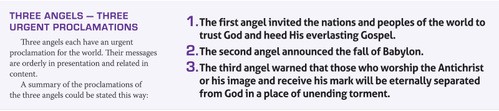
A summary of the proclamations of the 3 angels could be stated this way:
The 1st angel invited the nations and peoples of the world to trust God and heed His everlasting Gospel. This would be their last opportunity. God’s final wrath was about to be unleashed on the earth.
The 2nd angel announced the fall of Babylon. The one-world government of Antichrist would be totally destroyed in a day.
The 3rd angel warned that those who worship the Antichrist or his image and receive his mark will be eternally separated from God in a place of unending torment.
The message of the 144,000 – who are the firstfruits and given the promise of more fruit to come – is to the Jewish people (Revelation 14:1-5). The message of the 3 angels to the nations of the world, with the invitation to trust God while there is still a brief window of opportunity, is to the Gentile (Revelation 14:6-12).
I believe as a direct result of the messages of the 3 angels, the prophecy of the 2 witnesses (Revelation 11:3), and the testimony of the 144,000, the greatest revival the world has ever known will occur. And it will occur “in the nick of time.”
The final words of the 3rd angel are these: “Here is the patience of the saints: here are they that keep the commandments of God, and the faith of Jesus” (Revelation 14:12). The expression “patience of the saints” is an extremely important and beautiful concept. It means to remain faithful to God during the most difficult and trying of times – to endure to the end while under the oppressive hand of the Antichrist and the False Prophet.
John now hears a voice from Heaven. It is not the voice of one of the 3 angels. It is a new voice and the message is one of great comfort. John is told to write: “Blessed are the dead which die in the Lord from henceforth: Yea, saith the Spirit, that they may rest from their labours; and their works do follow them” (Revelation 14:13).
Some who heed the heavenly messages will suffer and be martyred for their steadfast fidelity to Christ during the Great Tribulation. They will refuse to take the mark of the Antichrist. On first reflection, how strange these words are to our ears. He wrote: “Blessed are the dead which die in the Lord from henceforth . . . .” We ask, “How are the dead which die in the Lord blessed?” But with a second reflection, the words take on new significance. Throughout the Bible, the word “bless” carries with it the idea of life.
The blessed man of Psalm 1 is the man or woman who has life. They are like a tree planted by the rivers of water – their leaves will not wither and whatever they do will prosper. The expression, “Blessed are the dead which die in the Lord” could literally be expressed this way: “Alive are the dead who died as martyrs for the Lord.”
What an amazing paradox! And the Lord God of the universe has a perfect memory: “Yea, saith the Spirit, that they may rest from their labours; and their works do follow them” (Revelation 14:13).
The 1st angel invited the nations and peoples of the world to trust God and heed His everlasting Gospel. This would be their last opportunity. God’s final wrath was about to be unleashed on the earth.
The 2nd angel announced the fall of Babylon. The one-world government of Antichrist would be totally destroyed in a day.
The 3rd angel warned that those who worship the Antichrist or his image and receive his mark will be eternally separated from God in a place of unending torment.
The message of the 144,000 – who are the firstfruits and given the promise of more fruit to come – is to the Jewish people (Revelation 14:1-5). The message of the 3 angels to the nations of the world, with the invitation to trust God while there is still a brief window of opportunity, is to the Gentile (Revelation 14:6-12).
I believe as a direct result of the messages of the 3 angels, the prophecy of the 2 witnesses (Revelation 11:3), and the testimony of the 144,000, the greatest revival the world has ever known will occur. And it will occur “in the nick of time.”
The final words of the 3rd angel are these: “Here is the patience of the saints: here are they that keep the commandments of God, and the faith of Jesus” (Revelation 14:12). The expression “patience of the saints” is an extremely important and beautiful concept. It means to remain faithful to God during the most difficult and trying of times – to endure to the end while under the oppressive hand of the Antichrist and the False Prophet.
John now hears a voice from Heaven. It is not the voice of one of the 3 angels. It is a new voice and the message is one of great comfort. John is told to write: “Blessed are the dead which die in the Lord from henceforth: Yea, saith the Spirit, that they may rest from their labours; and their works do follow them” (Revelation 14:13).
Some who heed the heavenly messages will suffer and be martyred for their steadfast fidelity to Christ during the Great Tribulation. They will refuse to take the mark of the Antichrist. On first reflection, how strange these words are to our ears. He wrote: “Blessed are the dead which die in the Lord from henceforth . . . .” We ask, “How are the dead which die in the Lord blessed?” But with a second reflection, the words take on new significance. Throughout the Bible, the word “bless” carries with it the idea of life.
The blessed man of Psalm 1 is the man or woman who has life. They are like a tree planted by the rivers of water – their leaves will not wither and whatever they do will prosper. The expression, “Blessed are the dead which die in the Lord” could literally be expressed this way: “Alive are the dead who died as martyrs for the Lord.”
What an amazing paradox! And the Lord God of the universe has a perfect memory: “Yea, saith the Spirit, that they may rest from their labours; and their works do follow them” (Revelation 14:13).
The Harvest
The end of this era of human history nears as the final section of Chapter 14 reveals what initially seems to be a description of 2 reapings of the earth (vv. 14-20). Among the numerous opinions, most commentators group these so-called “2 reapings” and identify them as the judgment of God upon a humanity that has embraced the Antichrist and taken his mark. Concern-ing the “1st reaping,” John wrote:
The end of this era of human history nears as the final section of Chapter 14 reveals what initially seems to be a description of 2 reapings of the earth (vv. 14-20). Among the numerous opinions, most commentators group these so-called “2 reapings” and identify them as the judgment of God upon a humanity that has embraced the Antichrist and taken his mark. Concern-ing the “1st reaping,” John wrote:
“And I looked, and behold a white cloud, and upon the cloud one sat like unto the Son of man, having on his head a golden crown, and in his hand a sharp sickle. And another angel came out of the temple, crying with a loud voice to him that sat on the cloud, Thrust in thy sickle, and reap: for the time is come for thee to reap; for the harvest of the earth is ripe. And he that sat on the cloud thrust in his sickle on the earth; and the earth was reaped” (Revelation 14:14-16).
In describing the “2nd reaping,” John said:
“And another angel came out of the temple which is in heaven, he also having a sharp sickle. And another angel came out from the altar, which had power over fire; and cried with a loud cry to him that had the sharp sickle, saying, Thrust in thy sharp sickle, and gather the clusters of the vine of the earth; for her grapes are fully ripe. And the angel thrust in his sickle into the earth, and gathered the vine of the earth, and cast it into the great winepress of the wrath of God. And the winepress was trodden without the city, and blood came out of the winepress, even unto the horse bridles, by the space of a [1,600] furlongs [about 184 miles]” (Revelation 14:17-20).
In the passages above, the so-called “2nd reaping” in verses 17-20 is obviously describing divine judgment upon the wicked which will be carried out by angels. However, a question arises as to why John differentiates this reaping from the so-called “1st reaping” in verses 14-16. And why is the “1st reaping” carried out directly by one who seems to be Jesus Christ himself?
Allow me to offer what I believe to be a plausible explanation that may serve to clarify these passages.
I believe these events must be understood within the larger context of the Day of the Lord (which is the time when God purges Earth and punishes the wicked). Scripture teaches that immediately prior to the outpouring of God’s wrath, He sends His angels to seal 144,000 Jews for protection (Revelation 7:3-8), He raptures the Church (Revelation 7:9-17), and then there is silence in Heaven for the space of a half-hour (Revelation 8:1). This series of events occurs in rapid-fire succession just prior to the start of His Day of the Lord wrath.
It is my conviction that, collectively, these are all part of a sequence of events that comprise the great harvest of Earth by Jesus Christ at the end of the age. In light of these things, I suggest Revelation 14:14-16 is simply stating that Christ will initiate the events of His final harvest when the time is right. And the time will be right when Earth is fully ripe.
In the phrase, “for the harvest of the earth is ripe” in verse 15, the Greek word used for “ripe,” is exeranthe, which implies the idea of being overripe to the point of being withered or dry. Some commentators take the position that the particular usage of this word, in combination with the previous phrase, “Thrust in thy sickle, and reap: for the time is come for thee to reap” is emphasizing a negative, wrathful aspect of His reaping. They therefore conclude this so-called “first reaping” is exclusively describing His punishment of the wicked in the lead-up to the battle of Armageddon.
While I am not dogmatic on this issue, I take the position that the connotation of the word “ripe”
in context here is not so much intended to negatively define the nature and character of that which will be harvested, but rather it is a condemnation denoting the condition of Earth at that time. The focus is on Earth, and the emphasis is on timing. In other words, when Earth is ready (fully ripe), it will trigger the time to separate the wheat from the weed.
At that time, the full spectrum of events associated with the final harvest (including the sealing of the 144,000, the rapture of the Church, and the judgment of the wicked) will be successfully implemented by Jesus Christ.
Regardless of one’s understanding of “the harvest” in verses 14-16, it is clear the verses that follow depict the climactic events associated with God’s purging of Earth of all that has defiled it since the fall of man in the Garden of Eden. These verses are all about “the great winepress of the wrath of God.”
It includes the destruction of the converging armies of the world at the battle of Armageddon in the Jezreel Valley; and the bowl judgments of God described in Revelation Chapters 15 and 16.
The God of creation and redemption is longsuffering and not desirous that any should perish, but a day will come when the cup of humanity’s iniquity is full and God says, “No more! Longsuffering is past.” Humanity cannot forever turn up its nose at God, ignore His law, and reject His grace.
Satan, the Antichrist, and the False Prophet may have their brief moment in Chapter 13, but the Lamb standing on Mount Zion in Chapter 14 is the Lion of the tribe of Judah – the Son of David – the Son of God, and He need only speak the word to smite them.
Allow me to offer what I believe to be a plausible explanation that may serve to clarify these passages.
I believe these events must be understood within the larger context of the Day of the Lord (which is the time when God purges Earth and punishes the wicked). Scripture teaches that immediately prior to the outpouring of God’s wrath, He sends His angels to seal 144,000 Jews for protection (Revelation 7:3-8), He raptures the Church (Revelation 7:9-17), and then there is silence in Heaven for the space of a half-hour (Revelation 8:1). This series of events occurs in rapid-fire succession just prior to the start of His Day of the Lord wrath.
It is my conviction that, collectively, these are all part of a sequence of events that comprise the great harvest of Earth by Jesus Christ at the end of the age. In light of these things, I suggest Revelation 14:14-16 is simply stating that Christ will initiate the events of His final harvest when the time is right. And the time will be right when Earth is fully ripe.
In the phrase, “for the harvest of the earth is ripe” in verse 15, the Greek word used for “ripe,” is exeranthe, which implies the idea of being overripe to the point of being withered or dry. Some commentators take the position that the particular usage of this word, in combination with the previous phrase, “Thrust in thy sickle, and reap: for the time is come for thee to reap” is emphasizing a negative, wrathful aspect of His reaping. They therefore conclude this so-called “first reaping” is exclusively describing His punishment of the wicked in the lead-up to the battle of Armageddon.
While I am not dogmatic on this issue, I take the position that the connotation of the word “ripe”
in context here is not so much intended to negatively define the nature and character of that which will be harvested, but rather it is a condemnation denoting the condition of Earth at that time. The focus is on Earth, and the emphasis is on timing. In other words, when Earth is ready (fully ripe), it will trigger the time to separate the wheat from the weed.
At that time, the full spectrum of events associated with the final harvest (including the sealing of the 144,000, the rapture of the Church, and the judgment of the wicked) will be successfully implemented by Jesus Christ.
Regardless of one’s understanding of “the harvest” in verses 14-16, it is clear the verses that follow depict the climactic events associated with God’s purging of Earth of all that has defiled it since the fall of man in the Garden of Eden. These verses are all about “the great winepress of the wrath of God.”
It includes the destruction of the converging armies of the world at the battle of Armageddon in the Jezreel Valley; and the bowl judgments of God described in Revelation Chapters 15 and 16.
The God of creation and redemption is longsuffering and not desirous that any should perish, but a day will come when the cup of humanity’s iniquity is full and God says, “No more! Longsuffering is past.” Humanity cannot forever turn up its nose at God, ignore His law, and reject His grace.
Satan, the Antichrist, and the False Prophet may have their brief moment in Chapter 13, but the Lamb standing on Mount Zion in Chapter 14 is the Lion of the tribe of Judah – the Son of David – the Son of God, and He need only speak the word to smite them.
Naomi: Tears to Triumph
April 23rd, 2026
It was more of an embittered accusation than a plea for mercy. But now was not the time to rail against God; Naomi had a crucial decision to make. As she paced alongside the main road that led out of the heathen nation of Moab, Naomi rehearsed her words. Two women and three mules were awaiting her decision. Satisfied she had found the right words, she returned to her companions. “Ruth, Orpah, plea...
Rapture & Wrath, Part 14: “The Empire of the Antichrist” (Revelation 17)
April 23rd, 2026
The identification of 7 historical empires used by Satan to accomplish his strategic purposes has been a central focus in this series of posts. In 3 different visions recorded in Revelation chapters 12, 13, and 17, John references a beast with 7 heads and 10 horns.
As the symbolism and significance of these heads and horns are revealed in the light of the prophetic Scriptures, the darkness that e...
Rapture & Wrath, Part 13: “The Seventh Beast Empire” (Revelation 17)
April 23rd, 2026
Difficult days are coming upon Earth, and the desire of our Heavenly Father is that we, as believers, are prepared.
He instructs us to live righteously as we watch expectantly for His Son’s glorious return (1 Thessalonians 5:4-10). In this regard, He has provided for us a wealth of vital prophetic information through His inspired penmen – the apostles and prophets.
You and I – or perhaps our so...